
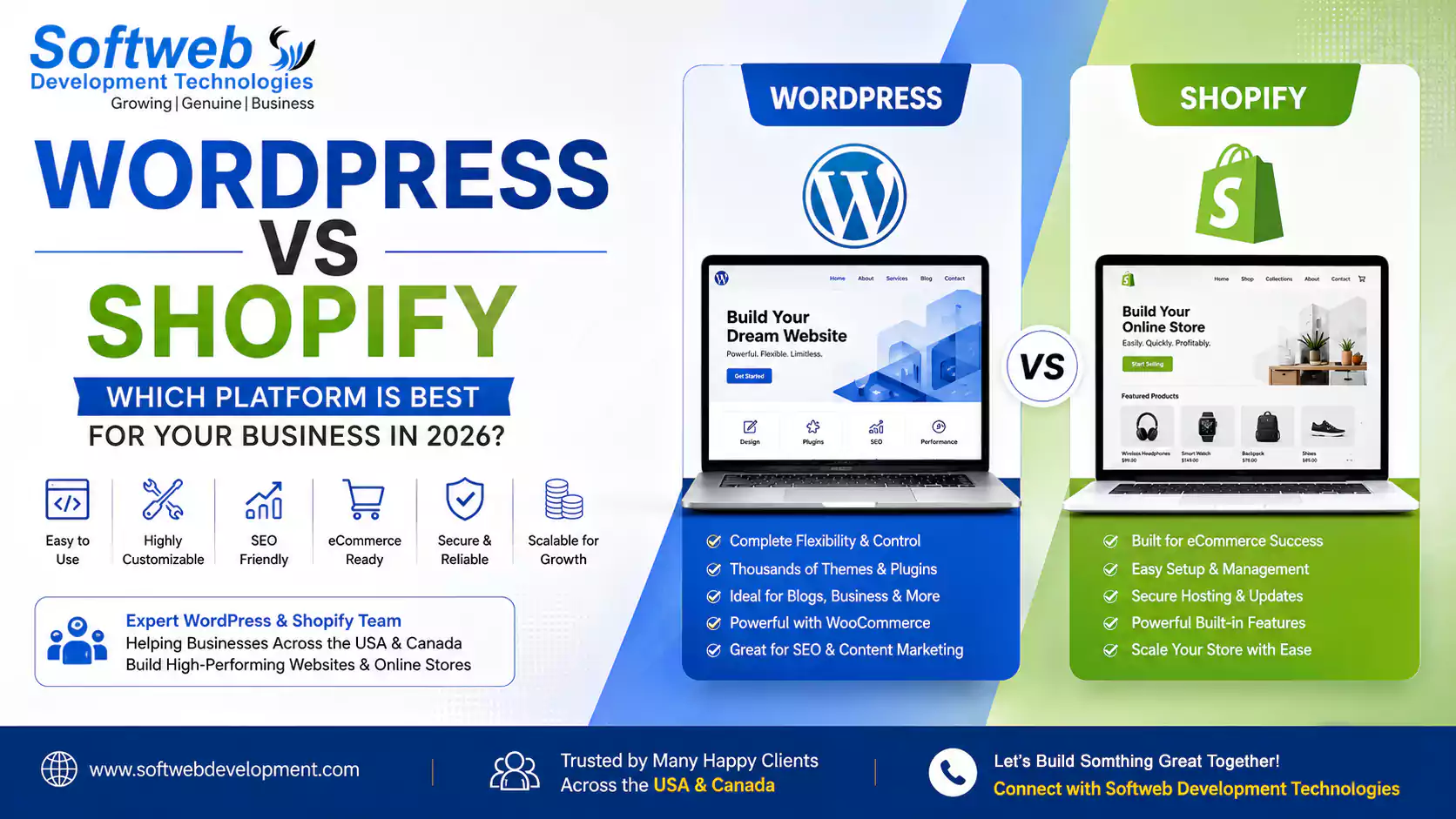
WordPress vs Shopify: Which Platform Is Best for Your Business in 2026?
 admin
admin WordPress vs Shopify: Which Platform Is Best for Your Business in 2026?
If you're planning to launch a new website or online store in 2026, you've probably encountered one of the biggest decisions business owners face: WordPress vs Shopify.
Both platforms power millions of websites worldwide and have earned strong reputations for helping businesses establish a successful online presence. However, they serve different purposes and offer unique advantages depending on your goals.
At Softweb Development Technologies, we've helped businesses across the USA and Canada build high-performing websites and eCommerce stores using both WordPress and Shopify. One question we hear repeatedly from clients is, "Which platform is right for my business?"
The truth is that there is no universal winner. The best choice depends on your business model, growth plans, budget, and technical requirements.
In this guide, we'll compare WordPress and Shopify in detail so you can make an informed decision for your business in 2026.

Understanding WordPress vs Shopify
Before comparing features, it's important to understand what each platform is designed to do.
What is WordPress?
WordPress is the world's most popular content management system (CMS), powering over 40% of websites globally. It provides unmatched flexibility, allowing businesses to create virtually any type of website, including:
- Business websites
- Blogs
- Corporate portals
- Membership websites
- Online learning platforms
- eCommerce stores using WooCommerce
WordPress is open-source, meaning you have complete control over customization, functionality, and hosting.
What is Shopify?
Shopify is a dedicated eCommerce platform designed specifically for selling products online.
Unlike WordPress, Shopify is an all-in-one hosted solution. It handles hosting, security, updates, and many technical aspects automatically, making it particularly attractive to business owners who want a streamlined online selling experience.
Shopify is designed to help businesses launch and manage online stores quickly and efficiently.
Ease of Use
Shopify Wins for Simplicity
One of Shopify's biggest strengths is ease of use.
The platform is designed for non-technical users. Business owners can create products, process orders, manage inventory, and customize their store without extensive technical knowledge.
Most Shopify stores can be launched relatively quickly.
WordPress Offers More Flexibility
WordPress has a steeper learning curve because it offers greater control.
Users need to manage hosting, plugins, updates, and security. While modern page builders have simplified website creation, WordPress still requires more involvement than Shopify.
For businesses seeking complete customization, this extra flexibility is often worth it.
Design and Customization
WordPress Leads in Custom Design
When it comes to design freedom, WordPress has a clear advantage.
Thousands of themes and plugins allow businesses to create highly customized websites tailored to their brand.
Whether you're building a corporate website, a real estate platform, a healthcare portal, or a custom marketplace, WordPress can accommodate virtually any requirement.
Shopify Focuses on Storefront Design
Shopify offers professionally designed themes that look modern and perform well.
However, customization options are generally more limited compared to WordPress.
For standard eCommerce websites, Shopify's themes work exceptionally well. But businesses seeking highly unique functionality may eventually encounter limitations.
eCommerce Capabilities
Shopify is Built for Selling
This is where Shopify truly shines.
Features included out of the box include:
- Product management
- Inventory tracking
- Secure checkout
- Payment gateways
- Shipping integrations
- Tax calculations
- Abandoned cart recovery
- Multi-channel selling
Everything is optimized for online sales.
For many retailers across the USA and Canada, Shopify provides everything needed to operate an efficient online store.
WordPress Requires WooCommerce
To create an online store with WordPress, most businesses use WooCommerce.
WooCommerce is powerful and highly customizable, but it requires additional setup and ongoing management.
The advantage is flexibility. Businesses can customize every aspect of the shopping experience without being restricted by a hosted platform.
For complex eCommerce requirements, WooCommerce often provides more freedom than Shopify.
SEO Comparison
WordPress Has Strong SEO Advantages
SEO remains a major consideration for businesses seeking organic traffic.
WordPress offers exceptional SEO flexibility through plugins such as:
- Yoast SEO
- Rank Math
- All in One SEO
Businesses can fully customize:
- URLs
- Metadata
- Schema markup
- Redirects
- Content structure
- Internal linking
This level of control makes WordPress a favorite among SEO professionals.
Shopify Delivers Solid SEO Performance
Shopify has significantly improved its SEO capabilities over the years.
The platform includes:
- Mobile-friendly architecture
- Fast loading speeds
- SSL security
- Automatic sitemap generation
While Shopify performs well for SEO, advanced users may find WordPress offers greater optimization flexibility.
Cost Comparison
Shopify Pricing
Shopify uses a subscription model.
Typical costs include:
- Monthly platform fees
- Premium themes
- Paid apps
- Transaction fees (depending on payment methods)
While predictable, costs can increase as your business grows and requires additional functionality.
WordPress Pricing
WordPress itself is free, but businesses must budget for:
- Hosting
- Premium themes
- Plugins
- Maintenance
- Security
- Development support
For smaller websites, WordPress can be cost-effective. For highly customized projects, costs may exceed Shopify due to development requirements.
Scalability and Growth
Shopify Supports Growing Stores
Shopify is designed to scale efficiently.
Many rapidly growing businesses choose Shopify because infrastructure, performance, and security are managed automatically.
Shopify Plus also supports enterprise-level brands handling significant sales volumes.
WordPress Scales with Custom Development
WordPress can scale almost indefinitely when properly developed.
Large corporations, publishers, and enterprise organizations use WordPress successfully because it can be customized to meet virtually any business requirement.
The key is having an experienced development team managing performance and infrastructure.
Security and Maintenance
Shopify Handles Security for You
Shopify manages:
- Hosting
- Security updates
- PCI compliance
- Server maintenance
- Software updates
This significantly reduces technical responsibilities for business owners.
WordPress Requires Active Management
With WordPress, security responsibilities fall largely on the website owner or development team.
Regular updates, backups, monitoring, and maintenance are essential.
This creates additional responsibility but also provides greater control.
Which Platform Should You Choose?
Choose WordPress if:
- You need a business website with extensive customization
- SEO is a major growth strategy
- You require custom functionality
- You want full ownership and control
- Your website extends beyond eCommerce
Choose Shopify if:
- Your primary goal is selling products online
- You want a fast launch process
- You prefer minimal technical management
- You need built-in eCommerce tools
- Simplicity is a priority
Why Businesses Choose Softweb Development Technologies
At Softweb Development Technologies, we understand that every business has unique goals.
Our experienced team has successfully delivered WordPress and Shopify solutions for startups, small businesses, and enterprise organizations across the United States and Canada.
Our expertise includes:
- Custom WordPress Development
- WooCommerce Development
- Shopify Store Development
- Shopify Plus Solutions
- Website Migration Services
- eCommerce Optimization
- SEO-Friendly Website Development
- Website Maintenance & Support
Rather than pushing one platform over another, we help clients select the solution that aligns with their long-term business objectives.
Final Thoughts
The WordPress vs Shopify debate doesn't have a one-size-fits-all answer. Both platforms are powerful, reliable, and capable of supporting business growth in 2026 and beyond.
If you're focused primarily on eCommerce and want simplicity, Shopify may be the ideal choice. If flexibility, content marketing, SEO, and customization are priorities, WordPress often provides greater opportunities.
At Softweb Development Technologies, our team of WordPress and Shopify experts helps businesses throughout the USA and Canada choose the right platform, build high-performing websites, and create digital experiences that drive measurable results.
The best platform isn't the one with the most features—it's the one that helps your business achieve its goals efficiently and sustainably.